Showing posts with label Diocletian. Show all posts

Thursday, March 13, 2014

Justinian and an Attempted Restoration

One of the striking features of the Decline and Fall of Rome is the persistent longing for its reestablishment by those who inherited its parts—and the Middle Ages are a period in which successive attempts to resuscitate the dearly departed actually took place. One of the first of these, curiously, was Alaric’s brother Athaulf (also Atawulf) the Visigoth who dreamt of recreating the Empire:

At first I wanted to erase the Roman name and convert all Roman territory into a Gothic empire: I longed for Romania to become Gothia, and Athaulf to be what Caesar Augustus had been. But long experience has taught me that the ungoverned wildness of the Goths will never submit to laws, and that without law a state is not a state. Therefore I have more prudently chosen the different glory of reviving the Roman name with Gothic vigour, and I hope to be acknowledged by posterity as the initiator of a Roman restoration, since it is impossible for me to alter the character of this Empire.
    [Circa 413, source Orosius, Historiae adversum paganos, quoted in Wikipedia (link)]

Another at least titular barbarian was Charlemagne (742-814), and he came closest to achieving it. The last famous name was Dante; in the fourteenth century he still dreamed of the reestablishment, this time, of the Holy Roman Empire.

An intermediate figure in this process was the East Roman Emperor Justinian (482-565). He made a stab at it himself when he launched the Gothic Wars in which, except for the end phase, the famed General Belisarius led most of the fighting—and the depopulation of Italy in the process—which cleared the field for the Lombard dominion, coming from the north, of Italy until Charlemagne came and defeated them in 774. Regarding Belisarius, I would recommend Robert Graves’ novel, Belisarius, which provides a genuine flavor of those times in rich detail.

Now for a broader context on that Eastern Empire. One might argue that the Roman Empire was split in two because its western half had become more and more ungovernable owing to barbaric invasions from the Germanic north certainly by the third century already—so much so that Emperor Diocletian (245-311), who first partitioned the realm politically into a tetrarchy, a rule of four, quite awarely acknowledged that ungovernability before the split. Under his design two emperors co-ruled, one in the West, one in the East. Two was turned into four by assigning each emperor a deputy, a Caesar. Caesars were to succeed Emperors and to appoint their own Caesars in turn. Each emperor (indeed each Caesar) had de facto sovereignty—and choice of capital. The capital of Rome therefore began to move around.

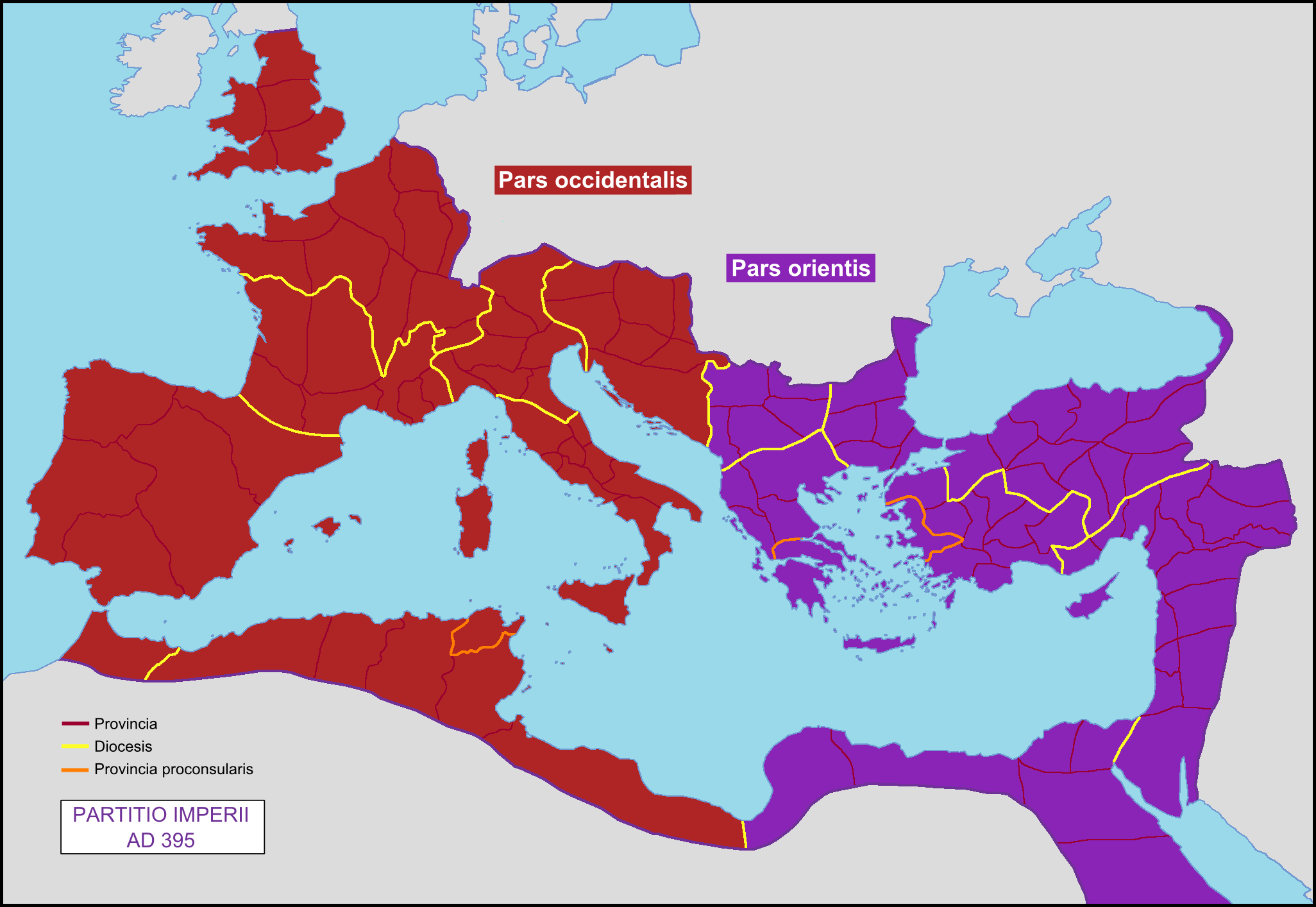
The Eastern empire consisted then of the regions south of the Danube, i.e. the Balkans, together with Greece, Turkey, Syria, Israel, Jordan, and Egypt. The great military pressures on this realm came from the north and east (Hunns, Avars, eventually Genghis Khan—and from the Germanic tribes that these incursions in turn threatened) and from the southeast pressure came from the Persians (the Sassanids). The map shows the divisions at around 395, year of the death of Theodosius, the last Roman Emperor who had managed to rule both realms at once:


Constantine transferred his center of power to Byzantium because the East was more stable and therefore also more prosperous than the West. It might also be noted here that a large proportion of Rome’s military leadership came from what is now the Balkans. Diocletian was born in today’s Croatia, Constantine in Serbia—and this move was also, you might say, going closer to home. Diocletian, after his retirement (a rare bird he, who actually resigned the emperorship) lies buried in what is now Split, Croatia, where he retired.


How the map had changed by Justinian’s time is shown above; its date is 526, the death of Theodoric. The Western Empire has become fragmented as shown by its many colors. The Eastern Empire was still intact but obviously under pressure from the west as well. In 535, some nine years after Theodoric’s death (he who painted that map above red) Justinian launched a war, really multiple thrusts. His inspiration was Gothic infighting over Theodoric’s legacy. One of Justinian’s thrusts was directed at the recovery of Italy, another at the conquest of the Vandals, and a third, which did not go very far, was an attempt at recapturing Spain. The results are shown below:


Note that Justinian’s two out-stretched hands have almost managed to recover most of the old territories of Rome West. But coloration of maps does not tell the whole picture. Justinian’s wars are labeled Pyrrhic victories. The war in Italy is called the Gothic War of 535-554; it might have been called the Second Gothic War because an earlier one, 376-382, is also called by the same name—but that conflict took place in the Balkans, thus in the actual territory of the Eastern Empire itself. The Goth, pressed north by Belisarius, came back a little more to the east. The Eastern Empire, after that, was on its last leg. Nor did the reconquest of Italy last any significant time. Just a decade after Justinian died, the situation in Italy had changed again. The Gothic War had devastated Italy, particularly its urban places. Historians use the word “depopulated.” Depopulation is, however, also an invitation. Lombards had come to take over significant parts of the country and would claim yet more of it. A map of Italy dated 575 shows the results. 

Let me now look ahead some 500 years or so, to 1092 and therefore the High Middle ages. The map that follows does this. It shows a greatly shrunken Byzantine state, an Empire in name alone. The Balkans have been overrun. And the green coloration of the southern regions, stretching up into Spain, signal a new element in history. Something called Islam has emerged and shows its wide-spread reality replacing Vandals and Visigoth.


Every coin has two sides. One side of the Medieval coin shows political fragmentation—and incessant warfare as now this tribal domain and now that other has its crack at becoming the new Augustus. The actors here are tribal ruling classes. Those who bear the pain are the resident populations. And that reveals the Medieval coin’s other side. The population of this once peaceful region—with all its wars far away on the limes, as the Romans called the frontiers, are now living in a world that, translated to our times, would resemble rule by very large motor cycle gangs. The yearning for peace—and the courage to overcome the hardship of this age—is provided by a common faith which, while the battles keep raging on, is slowly forming a new culture: Christendom. This culture comes gradually to overlay these different realms. But it is much more difficult to illustrate it with maps; nevertheless, I’ll attempt to make it “visible” in my next attempt in this series.
----------------
Images: Empire in 395: Wikipedia (link); Europe in 526: Wikipedia (link); Italy in 575: Wikipedia (link); Byzantine conquests: RealHistory (link);  Europe in 1092: Wikipedia (link).

Wednesday, September 26, 2012

How Close Are We to the End Times?

A piece on the future as it gradually unwraps for our view on truthdig.com, “Growth is the Problem,” by Chris Hedges (link), prompted Brigitte to wonder what the social conditions were like in Rome just before the Roman Empire collapsed. Good question—but really a trick question. Arguably we have not yet reached that stage in civilization matching the end of Rome. That began around about the time of Diocletian (244-311 AD) when that emperor partitioned the Roman Empire in 295 AD. In our times, in the United States, we’re still waiting, as it were, for that decisive marker, the crossing of the Rubicon (49 BC)—the first clear sign that the end of the Republic has arrived. But let us take a look at what led up to that.

In 494 BC the Roman Republic was just 15 years old when a general strike, as we would call it today—they called it the Secession of the Plebs—signaled a period known as the Conflict of the Orders, thus between the Patricians (call them the oligarchy of the wealthy) and the Plebeians (call them the common people, more recently the 99%, more recently yet, the 47%). The first consul of the republic, one Appius Claudius Sabinus Inregillensis, behaved so harshly that the common people left the city en masse and repaired to one of the hills of Rome (Mons Sacer), and effectively shut down the economy. This resulted in the creation of the representatives (tribunes) of the people. The first Secession of the Plebs was followed by others in 449, 445, 342, and 287 BC. Hence the Conflict of the Orders was said to extend 494-287, a period of 207 years. But, in fact, that conflict never really ended until the Roman Empire dawned  with Octavian’s ascension to the throne in 27 BC.

The formation of the Plebeian Council, which elected tribunes, became functionally similar to a lower house. In fact it was more powerful, eventually, than the Senate of Rome. It came to represent what today we’d call the Left—and its principal strategy was income redistribution, its secondary but closely related strategy was distribution of power—to its own members and to the lesser nobility, the equites or knights. Income in the Roman context was land. Land to be distributed was land conquered by Roman armies.

Concerning land, it was the emblem of the franchise itself. Land-owning plebeians were entitled to vote—and also obliged to serve in the military. The Romans were straightforward realists. Material power was political power. The abstract notion of individual liberty had not yet dawned. We have to thank Christianity for that.

The end-times of the Republic really began in the second century BC when the Gracchi brothers, Tiberius Gracchus (162-133 BC) and Gaius Graccchus (154-121 BC) both tribunes, passed laws distributing land to the plebs; both were murdered in the convulsions that resulted. Despite such setbacks in detail—and the Senate was oblige to accept some of the reforms voted into place to avoid massive conflagrations—the Plebs gradually gained more and more power in Rome. Its tribunes would eventually hold the Consulship and the Censorship and acquired seats in the Senate itself.

At the same time—and such is real life—periods of crack-down appeared, most notably during the right-wing dictatorship of Lucius Cornelius Sulla (138-78 BC). But the impulse set in motion by the first Secession of the Plebs continued right on after Sulla’s death and produced, first, Caesar and then the caesars.

The historical path described here is one beginning with the dictatorial monarch, in this case Lucius Lavinius Superbus (535-496 BC), to the arising of Augustus (63 BC - 14 AD). Augustus, known as Octavian before he took power, hailed from the equestrian branch of a plebeian family—but he had been raised to patrician rank by adoption by Julius Caesar. (That, by the way, tells you how the poor (plebeian), grown wealthy (equestrian), could be enlisted in the ranks of the nobility (patrician) by adoption. In our pre-democratic times the method was to marry a wealthy daughter into the nobility.) Between those two monarchs lay a period of 482 years during which an oligarchy ruled, was gradually weakened, and totalitarianism became possible again.

Now for those who dream of reestablishing the old-fashioned patrician rule over the masses, all I can say is—dream on. And those who dream of the ultimate victory of the 99 percent, they’re also just dreaming. When the left finally wins, what follows then is military rule. Want to secure your long term future? Join the Army. If we follow anything like the Roman pattern, we are now still in the midst of the battle between the patricians and the plebs. We’ve clocked 236 years from the establishment of our own republic. If the same pattern holds, the crossing of the Rubicon will take place circa 2236—and then roughly another 300++ years of empire are waiting before the end times even begin. Now, of course, the two situations have major dissimilarities. For instance. We’ll have run out of fossil fuels when the next century begins. And that may speed things up a little…
---------------
My illustrative emblem, the icon of the Roman Empire, comes from Wikipedia (link). The acronym stands for Senātus Populusque Rōmānus (“The Senate and People of Rome”).

Monday, June 8, 2009

Economic Foundations

The writing of blog entries, with the implied possibility that people all over the world might just chance to see it, has a somewhat bracing effect on something that I’ve engaged in all of my life—the keeping of diaries or notes. When doing the latter the only presumed audience is yourself, and the reasonable use of the time is to clarify ideas. But when you have the feeling of people peering over your shoulder, you tend to feel the pressure to get things right, to look things up. The process becomes more stimulating. You tend to follow up on hunches and seek out the hard copy of things you remember reading. Thus one of my recent posts somewhere reminded me that the late Stephen J. Gould had written a scathing book about abuses in science. Gould has figured in my thought as a genuinely original thinker—on evolution and much else. It was he who proposed an explanation of evolution (with Niles Eldredge) by a process of “punctuated equilibrium,” thus abrupt departures over against gradualistic changes based on tiny increments. I happen to have a minor (and meaningless) link to the man in that we shared the same literary agent over many years. In any case, having been reminded, I found one of three copies I own of Gould’s The Mismeasure of Man and put the book on my nightstand. But this only by way of introduction—and a little plug for a fine writer on difficult scientific subjects.

I spent several nights perusing the book, particularly the dreary story of how IQ testing began and why it is the sham that it is. But the other night, and now we’re getting warmer, I dreaded once more being awash in the abuses of thought to which Modernity is prone. And not wishing to get out of bed again for one of those midnight hunts of my shelves, I just eased out a volume within my reach but buried deep in time and began rereading Will Durant’s Caesar and Christ. The book was there because quite a long time ago I was restudying the reign of Diocletian—and in the course of that discovered that both that great emperor as well as Constantine were what today we would call Serbs—not Italians at all. In fact when Diocletian retired—to raise those prize chickens of his—he did so in what is today Split, the largest coastal city of Croatia on the Adriatic.

I skipped the introductory chapters that take us to the dawn of Caesar’s time and began reading Chapter VI, “The Agrarian Revolt”—and once more felt the shock I’d felt on the last reading years ago, as my marginal notes throughout the book make clear. I put a representative quote on another blog, visible here, explaining the causes of the revolt which, in due time, set the stage for Caesar’s rise and the days of empire in Rome: slavery. My marginal notes and my refreshed memory of the first reading have to do with the economic foundations of civilization. Ancient civilization was undoubtedly based on agriculture; and Rome’s slow-motion collapse began with the introduction of slavery on a large scale. Rome had transformed its economic base from yeoman farming to military conquest—which yielded the slaves and impoverished its masses. And for me this has obvious parallels in that American civilization was also founded on agriculture; indeed, it was heavily supported by—guess what? Slavery. When cotton was king, it was slaves that produced it. Only later, when we discovered a new kind of slave, did the economy shift from agriculture to industry. That industry, in turn, manifesting predominantly in manufacturing, depends on energy slaves, the fossil fuels.

Now it is worth noting that the imperial period of Rome dawned when the importation of slaves on a grand scale began to deform the Roman Republic—as the quotes on LaMarotte clearly show in summary. We face a similar but two-pronged challenge today, albeit we appear to be at an earlier stage of the problem. And these things are all too clear to me because, for the past twenty years, I’ve either been directly or indirectly the chronicler of manufacturing in the United States—in a statistical series originally called Manufacturing USA and now Manufacturing & Distribution USA. I looked up some data the current editor, Joyce P. Simkin, has complied in the latest edition. It shows decline in manufacturing employment (this predates the automotive collapse) from 17.8 to 13 million people between 1982 and 2006. The decline has been accelerating. This is one prong of the challenge—our yielding a function to imports, not of slaves, as it were, but to those who work at much lower wages than we pay. The second prong of the challenge is that manufacturing in the modern sense is unimaginable without fossil fuels, and we can now clearly see that these fuels will be pretty much exhausted by the end of the twenty-first century.

When I then peruse the shocking consequences to society that the heavy uptick in slavery produced in Rome, I find it entirely appropriate to suggest that we should put our house in order, at every level, in anticipation of bad times to come—not just the usual bad times that come routinely, punctuating our equilibrium, but major transformations that will make the future, even if we master fusion power, utterly different from what we see all around us today.