Thursday, March 13, 2014

Justinian and an Attempted Restoration

One of the striking features of the Decline and Fall of Rome is the persistent longing for its reestablishment by those who inherited its parts—and the Middle Ages are a period in which successive attempts to resuscitate the dearly departed actually took place. One of the first of these, curiously, was Alaric’s brother Athaulf (also Atawulf) the Visigoth who dreamt of recreating the Empire:

At first I wanted to erase the Roman name and convert all Roman territory into a Gothic empire: I longed for Romania to become Gothia, and Athaulf to be what Caesar Augustus had been. But long experience has taught me that the ungoverned wildness of the Goths will never submit to laws, and that without law a state is not a state. Therefore I have more prudently chosen the different glory of reviving the Roman name with Gothic vigour, and I hope to be acknowledged by posterity as the initiator of a Roman restoration, since it is impossible for me to alter the character of this Empire.
    [Circa 413, source Orosius, Historiae adversum paganos, quoted in Wikipedia (link)]

Another at least titular barbarian was Charlemagne (742-814), and he came closest to achieving it. The last famous name was Dante; in the fourteenth century he still dreamed of the reestablishment, this time, of the Holy Roman Empire.

An intermediate figure in this process was the East Roman Emperor Justinian (482-565). He made a stab at it himself when he launched the Gothic Wars in which, except for the end phase, the famed General Belisarius led most of the fighting—and the depopulation of Italy in the process—which cleared the field for the Lombard dominion, coming from the north, of Italy until Charlemagne came and defeated them in 774. Regarding Belisarius, I would recommend Robert Graves’ novel, Belisarius, which provides a genuine flavor of those times in rich detail.

Now for a broader context on that Eastern Empire. One might argue that the Roman Empire was split in two because its western half had become more and more ungovernable owing to barbaric invasions from the Germanic north certainly by the third century already—so much so that Emperor Diocletian (245-311), who first partitioned the realm politically into a tetrarchy, a rule of four, quite awarely acknowledged that ungovernability before the split. Under his design two emperors co-ruled, one in the West, one in the East. Two was turned into four by assigning each emperor a deputy, a Caesar. Caesars were to succeed Emperors and to appoint their own Caesars in turn. Each emperor (indeed each Caesar) had de facto sovereignty—and choice of capital. The capital of Rome therefore began to move around.

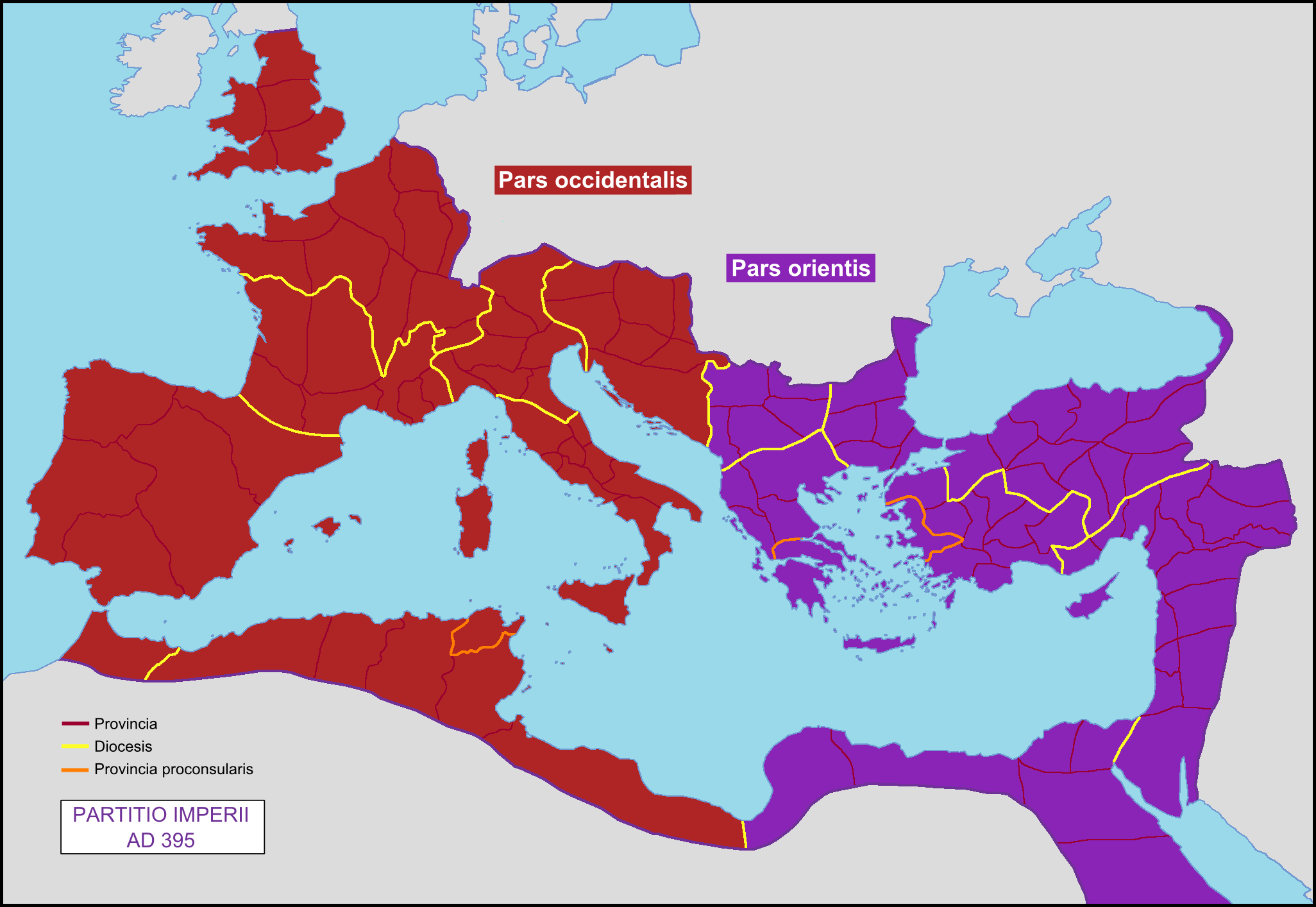
The Eastern empire consisted then of the regions south of the Danube, i.e. the Balkans, together with Greece, Turkey, Syria, Israel, Jordan, and Egypt. The great military pressures on this realm came from the north and east (Hunns, Avars, eventually Genghis Khan—and from the Germanic tribes that these incursions in turn threatened) and from the southeast pressure came from the Persians (the Sassanids). The map shows the divisions at around 395, year of the death of Theodosius, the last Roman Emperor who had managed to rule both realms at once:


Constantine transferred his center of power to Byzantium because the East was more stable and therefore also more prosperous than the West. It might also be noted here that a large proportion of Rome’s military leadership came from what is now the Balkans. Diocletian was born in today’s Croatia, Constantine in Serbia—and this move was also, you might say, going closer to home. Diocletian, after his retirement (a rare bird he, who actually resigned the emperorship) lies buried in what is now Split, Croatia, where he retired.


How the map had changed by Justinian’s time is shown above; its date is 526, the death of Theodoric. The Western Empire has become fragmented as shown by its many colors. The Eastern Empire was still intact but obviously under pressure from the west as well. In 535, some nine years after Theodoric’s death (he who painted that map above red) Justinian launched a war, really multiple thrusts. His inspiration was Gothic infighting over Theodoric’s legacy. One of Justinian’s thrusts was directed at the recovery of Italy, another at the conquest of the Vandals, and a third, which did not go very far, was an attempt at recapturing Spain. The results are shown below:


Note that Justinian’s two out-stretched hands have almost managed to recover most of the old territories of Rome West. But coloration of maps does not tell the whole picture. Justinian’s wars are labeled Pyrrhic victories. The war in Italy is called the Gothic War of 535-554; it might have been called the Second Gothic War because an earlier one, 376-382, is also called by the same name—but that conflict took place in the Balkans, thus in the actual territory of the Eastern Empire itself. The Goth, pressed north by Belisarius, came back a little more to the east. The Eastern Empire, after that, was on its last leg. Nor did the reconquest of Italy last any significant time. Just a decade after Justinian died, the situation in Italy had changed again. The Gothic War had devastated Italy, particularly its urban places. Historians use the word “depopulated.” Depopulation is, however, also an invitation. Lombards had come to take over significant parts of the country and would claim yet more of it. A map of Italy dated 575 shows the results. 

Let me now look ahead some 500 years or so, to 1092 and therefore the High Middle ages. The map that follows does this. It shows a greatly shrunken Byzantine state, an Empire in name alone. The Balkans have been overrun. And the green coloration of the southern regions, stretching up into Spain, signal a new element in history. Something called Islam has emerged and shows its wide-spread reality replacing Vandals and Visigoth.


Every coin has two sides. One side of the Medieval coin shows political fragmentation—and incessant warfare as now this tribal domain and now that other has its crack at becoming the new Augustus. The actors here are tribal ruling classes. Those who bear the pain are the resident populations. And that reveals the Medieval coin’s other side. The population of this once peaceful region—with all its wars far away on the limes, as the Romans called the frontiers, are now living in a world that, translated to our times, would resemble rule by very large motor cycle gangs. The yearning for peace—and the courage to overcome the hardship of this age—is provided by a common faith which, while the battles keep raging on, is slowly forming a new culture: Christendom. This culture comes gradually to overlay these different realms. But it is much more difficult to illustrate it with maps; nevertheless, I’ll attempt to make it “visible” in my next attempt in this series.
----------------
Images: Empire in 395: Wikipedia (link); Europe in 526: Wikipedia (link); Italy in 575: Wikipedia (link); Byzantine conquests: RealHistory (link);  Europe in 1092: Wikipedia (link).

Wednesday, March 12, 2014

A Neo-Barbarian Heresy

In developing the last post on Arianism, the quite different concept of Aryanism spontaneously came to mind—simply by sound associations and, further, that in German “Aryan” is spelled “arish” and the Aryans are “die Arier.”  Both words designate heresies, to be sure, but Aryanism is a pseudo-scientific race-theory whereas Arianism is a Christian heresy. The word with a Y has its roots in linguistics. Aryan was spoken in the very dim past by an Indo-European peoples; their language used that word to designate themselves. The people have left us nothing about their religion and culture. The new use of the word by the Nazis owes something to a secular heresy centered on the superiority of some races over others, first rendered in plain French by Arthur de Gobineau in his Essai sur l’inégalité des races humaines (1852-1854). For Gobineau the purest survival of the Aryan race was the nobility of France. One gets the idea.

Every phase of human culture has its heresies, be its orientation transcendental and therefore vertical or progressivist and therefore horizontally pointing to the future. But it is striking that, once we abandon a transcendental viewpoint, the heresy also becomes rather rude. Master Race, anyone? Better yet, Superman?

Tuesday, March 11, 2014

Arius and His Converts

[Fourth in a series on the Middle Ages: first, second, and third.]

One of the more interesting but not often mentioned aspect of the Middle Ages was that four of the five major Germanic tribal groups that held sway in the early centuries of this period were Arians rather than Catholics. That sort of thing might have little bearing in modern times; both were Christian, after all. But those days were meaningfully different. An Age of Faith was dawning.

The tribal grouping of the Franks were converted from raw paganism to the Catholic faith as they entered Roman realms. They were lucky, you might say; they became the ultimate winners. The Visigoths (in Spain), the Ostrogoths (in Italy), the Vandals (in Africa), and the Lombards (in Italy later) arrived already Christian—but also already labeled as heretics. That labeling took place in the First Council of Nicea convened by Emperor Constantine in 325, thus roughly 150 years before (in our eyes) the Middle Ages even began (476). Reality, however, is no respecter of firm dates.

The Franks spread over an area that had been Catholic for at least a century; their own faith made them acceptable as rulers; indeed they ruled under a higher umbrella, that of the Church. The other four groupings of barbarians were admired, to be sure, not least for their chastity (!), their honor, their tolerance of Catholics (except for the Vandals), and prowess in arms; but, as Arians, they were resisted because the Church, and the resident population which looked to the Church for guidance, saw them as religiously alien in a time that seemingly longed for unity at the highest levels of Church and State. Different times, those…

Now Arianism itself is an odd phenomenon. I was tempted to title this post “Arius and the Unintended Split in Christianity” or “Arius—Who Lent His Name.” For those of us who’re  theology-blind (in the sense of color-blind), the differences between Trinitarians and Arians is almost too difficult to see. In day-to-day practice they were the same. But they had their own clergy.

 In a gross simplification, the Arians held that Christ was created by God and was, therefore, not coeval with the Father. One of their Biblical citations was John 14:28 in which Jesus says, “the Father is greater than I.”  (Jesus also says, in John 10:30, “I and my Father are one,” but the total context is also ambiguous.) To be sure, the Arians did not hold that Jesus was merely a man; he was much more than man, but less than God the Father.

Now as for Arius, very little is known of him. He became a presbyter or priest in Egypt, in Alexandria. He was an avid student of others’ writings and held a view that had been in circulation evidently for decades before he himself became controversial. He became the focus of attention, briefly, when, in attempts at defending himself against accusations of heresy—he pointed to others much more prominent than he was. My own impression—and that’s all it is—is that Arius was a scholar, a minor figure, and not a leader either in thought or by force of personality. In effect he did lend his name to a controversy, and by triggering it, made it widely known. Once it spilled over into other Catholic regions from Egypt around 319, it eventually led to the Council of Nicea. But it was never a belief held even by a significant minority. Some 300 bishops attended the Council of Nicea; only two of that number refused to sign the Nicene Creed—showing the minority status of this sect.

Elements of Arianism, however, survived the reach of Nicea on the fringes of the Empire and in the Byzantine realm. From there an Arian bishop, Ulifas, ventured into the Balkans and succeeded in converting the Goths to Christianity of the Arian kind. That version of the faith also penetrated other Germanic tribes to the north, by and by, including parts of the Lombards; to see where they were circa 526, see the first map in the post shown here. Two Byzantine emperors (Constantius II, son of Constantine) and Valens were linked to Arianism, Constantius in a minor way, Valens with fewer vacillations and second thoughts.


One way to get a handle on the early Middle Ages is to see who ruled Italy. This period began with Italy’s rule by Odoacer (r. 476-493); he was of Germanic origin but presumably a pagan. Next comes Theodoric’s West Gothic Kingdom (lasted 493-553), which is Arian. His death in 526 eventually lead to the Gothic War of 535-554, Emperor Justinian’s attempt to reclaim Italy. This was a period of interregnum which greatly depopulated Italy. The next rule of that area was by the Lombards, large elements of which adhered to Arianism as well. The map shows the Lombard holdings at their heights. Lombard rule in Italy, never unified, lasted from 568 to 774. Note here that the Lombards did not hold Rome itself; Rome was independent. The Lombards were ruled by separate duchies, but they encircled Rome. Over time this pressure became dangerous, as viewed by the Church. And the end of any kind of Arian rule came when Pope Hadrian I called upon the Franks for help; and their king, Charles I, responded. That Charles, of course, was Charlemagne. He brought Italy under Frankish and therefore Catholic rule.

So what remains of Arianism in our day? Well, there is an interesting relic, part of a column in the Basilica of Sant’Apollinare Nuovo in Ravenna. The wall shown in the inset once showed an elaborate scene of Theodoric, the West Gothic ruler, and his entourage. But, as we know from George Orwell, when ideologies change, history tends to be rewritten by the winners. Therefore, in later times, the image of this Arian ruler was replaced with blank walls and curtains, but those who did the changing of the message must have had a sense of humor. They left a little thing in place, one hand grasping a column for support—an Arian hand no doubt.

Although the Lombards have actually left their mark on today’s Europe (the region of Lombardy in northern Italy, with Milan now its capital), the other Arian groupings have passed from view—except for that hand above. The Arian phenomenon, however, has something to teach us. Anything can serve as a support for identifying some collective as “the other” or as “the alien,” even when the effective content of the ideology rests on a difficult intellectual distinction which does not reach down to the working level or moral decisions. Those of us who are theology-blind are so because the Arian-Trinitarian conflict rests on conceptual distinctions which are not really “visible,” be it to our sensory apparatus or to what might be called “concrete” revelation; the Trinity is nowhere spelled out, as such, in the Gospels—or mentioned by Jesus. These distinctions are graspable only by intuition—which is personal and therefore not capable of verification in the public square. But Arianism, as an ideological projection, had quite concrete political consequences. Those who held it could not retain their grip on large enough populations to prevail. Sic transit, etc.
----------------
Images: Lombard Italy: Wikipedia (link); the regions shown are Neustria, Austria, Tuscia, and the Lombard Duchies of Spoleto and Benevento; the borders of the last are a little fuzzy. The Hand on the Column: Wikipedia (link).

Monday, March 10, 2014

Recalling Kennan—Again

I recall reading or hearing someone who said that people only have a few favorite records and they play them over and over again. That must have been a long time ago because the word “record” was used, instead of CD. I smiled wryly then because I found it true of me. There are only a handful of genuinely memorable figures that make a deep impression—on this or that aspect of life. Meanwhile life repeats the same patterns, and the same names therefore surface.

I’ve written five other posts here in which I recall the American diplomat, George Kennan (1904-2005). Kennan was a realist in international relations; he advocated that such relations should narrowly reflect national interest. This view does not suit the American political classes; they operate under the delusions of exceptionalism and would have us believe that our national interest does not diminish with distance from our shores. Hence, despite his influence, Kennan was marginalized.

Some of us, however, think that rational approaches, which favor humility, are sound when dealing with crises elsewhere. Instead we go into paroxysms of outrage when the advance of the Four Horsemen of our times (I’d called them Enlightenment, Secularism, Democracy, and Capitalism here) are opposed somewhere in  the world, i.e., by Putin in Russia. Let’s just calm down. The Crimea is a matter of Russian national interest. A simple way of putting it might be: “What Khrushchev gave Putin can take away.”

Sunday, March 9, 2014

Theodoric and Encircling German Arms

The main problem of understanding a period like the Middle Ages—560 some odd years after it ended in 1453—is forming a reasonably workable chronology that connects the various stages whereby the Roman Empire became transformed into two branches of Christendom.

I begin this third post on the Middle Ages (herewith the first and second) with a map of Europe in 526. It has the merit of marking the 50th year of the Middle Ages, assuming that that period began in 476, the year when Italy when Odoacer, a Germanic prince, deposed the last emperor of the Western Roman Empire and established the Kingdom of Italy. But let’s recall my suggestion that the period could also be dated from the death of Attila in 453. This map also permits us to link back to that time. In the following year, in 454, the Goths defeated the forces of Attila in the Battle of Nedao†—and the East Goths, whom Attila had displaced, once more took over. In that year another great figure saw the light of day, also in what is now Hungarian territory. He was Theodoric the Great. And his life ended 72 years later, in 526, at Ravenna, capital of the Kingdom of the East Goths, shown in red at the center of my map. That kingdom survived him, but not for long. It lasted for another 26 years under seven successors of Theodoric (none of whom had much of a reign), and then reverted back, but only vaguely, to the Byzantine Empire under Justinian the Great.

At his death Theodoric (some prefer Theoderic) was not only king of the Ostrogoths, he was also regent of the Kingdom of the West Goths in Spain, and, titularly only, he was acting as the viceroy for the Byzantine Emperor. That sort of arrangement was quite common in those times. At Emperor Zeno’s suggestion, Theodoric moved his tribe, numbering maximally 200,000, to put an end to Odoacer’s Kingdom of Italy; he also executed Odoacer; but Odoacer himself had also been a viceroy of the Byzantine Empire. More interestingly, perhaps, for those of us who imagine that labels like “barbarian” should be understood literally, Theodoric spent his youth (to age 31) in Constantinople as a hostage. He was educated there, indeed held the consulship of the empire for a year. Such “barbarians” as Theodoric might be better pictured as foreign rulers today who’ve had their education in the United States, studied law at Harvard, and speak English like Americans.

Now to those “encircling arms.” My map—remember that we’re only at the start of the Middle Ages—shows four large regions of which three are already called kingdoms. The large eastern yellow area was occupied by Germanic and Slavic tribes. The two large kingdoms to the south are Goths: Visigoths to the west, Ostrogoths to the east. The northern-most is the Kingdom of the Franks. I learned here that, unless you get too picky, that Visi may be understood as Western and Ostro as Eastern; the best way of understanding these directional prefixes is to say that they indicate where the Goths originally came from—the Visigoth from the Western, the Ostrogoth from the Eastern edges of what we now call Scandinavia. The Ostrogoths came upstream on the Vistula river (now in Poland) and eventually spread eastward into Russia, southward into the Balkans, and then turning west again, penetrated Europe from the east. The Visigoth took a western route, passing through what is now France to occupy Spain.

This general movement of Germanic peoples—with many, many different names—also pushed others south, east, and west. The Angles and the Saxons occupied much of England and pushed the Celts to Ireland and Scotland; Saxons also hung on to territory in Germany. The name, German, evidently came from the Celts. Celts had long occupied what is now France before being pushed to England—unless you agree with those who say that they occupied England first arriving by water from as far away as Greece. The Franks were one of these “pushed tribes,” if I may use that phrase, pushed south and west, but, later on, the tribal name was applied to others—much as, today, we speak of Hispanics without ever specifying where their genes originated geographically.

While occupied with tribal names, the German name for Germans, Deutsche, derives from the Teutons, who originally lived in what is now East Russia and Poland. We pronounce that word as “tootons,” but if we pronounce the eu differently, it sounds more like “toytons,” corresponding with the German pronunciation of “deu.” The largest and most prominent German tribe was the Suebe or Suevi, spread over territories of today’s Poland and Germany. That same word, in German, is Schwaben, a word much used in Poland, to this days, when referring to Germans. A small tribal element of the Suevi (no doubt numbering some 200,000 people or so) also reached as far as today’s Portugal on my 526 AD map. The Bavarians, shown in the yellow region of the map, stayed pretty much where they still are. As for the Lombards, the Bavarians’ eastern neighbors, they were destined eventually to take much of northern Italy when Theodoric’s realm fell apart and the Byzantine reconquest fizzled. In 526 they were still waiting their turn to engage in proper Völkerwanderung.

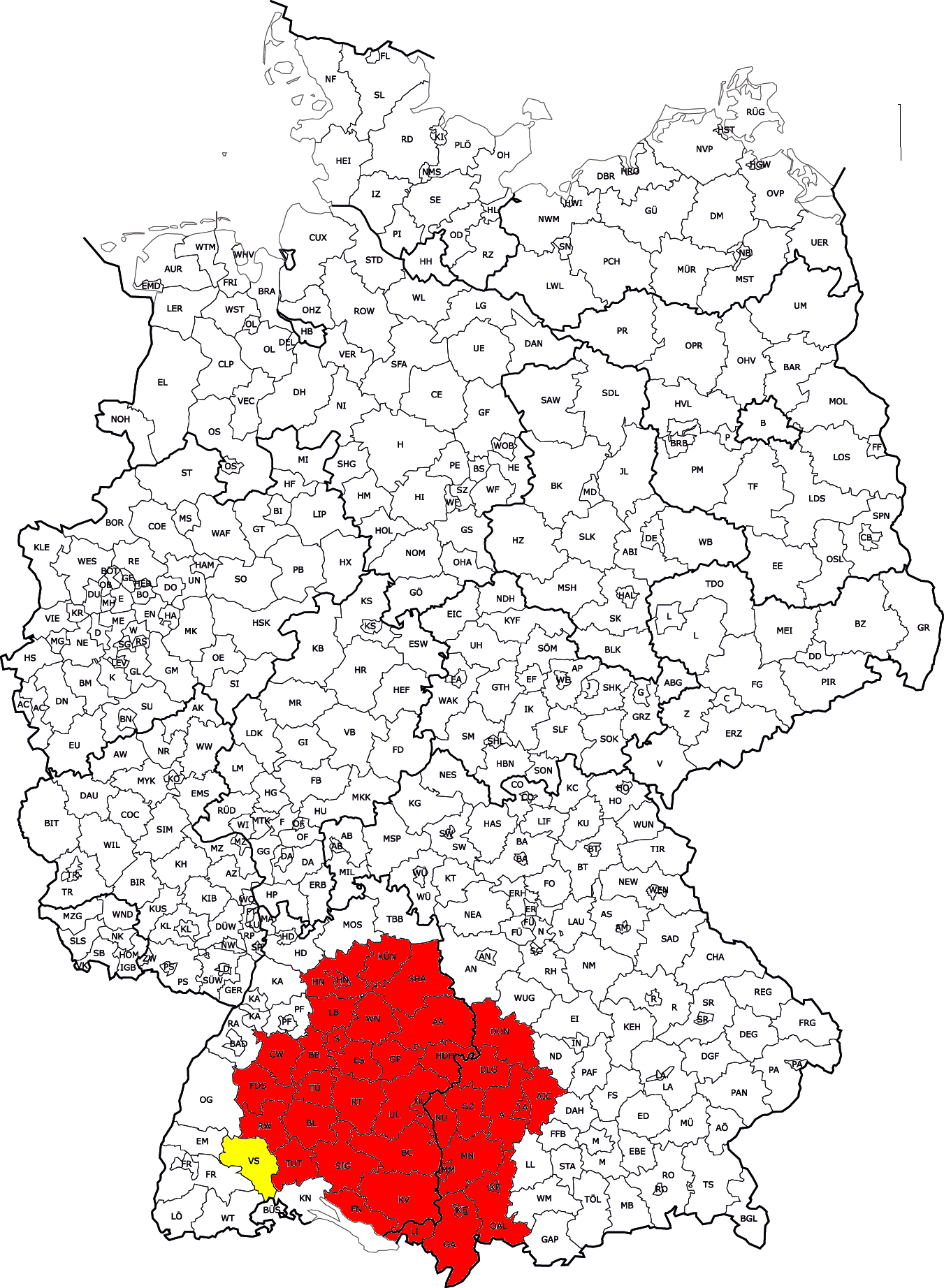
Now if we look at that map and try to predict an ultimate Big Winner, the bet should be on the Franks. They would spread in all available directions and eventually produce the Holy Roman Empire. The Visigothic realm lasted longer than the Ostrogothic. And there is a story behind that that has everything to do with religion. The Franks were Catholic, the Visigoths became converted from Arianism to Catholicism and therefore lasted longer. The Ostrogoths, Arians to the end, have passed into time. Within this European mainland we still have a Saxony, a Swabia (I am showing the region on a modern map of Germany as an inset), but nowhere do we see a Gothia anywhere. Sometimes nothing fails like success.

The Arian faith—not to be confused with the Aryan race of which Herr Hitler was so fond—will be our subject in the next post on the Middle Ages.
----------------
† The battle in what is now the Balkans; it takes its name from the Nedava, a tributary of the Sava river, itself a major tributary to the Danube. The Drina, made famous by literature, The Bridge on the Drina by Ivo Andric, is another Sava tributary.

Image sources. Map of 526 AD: Wikipedia (link); the Vistula river basin: Wikipedia (link); Swabia as part of modern Germany: Wikipedia (link).

Tuesday, March 4, 2014

Augustine and the Visigoths and Vandals

[Second in a series on the Middle Ages. The first is here.]

If the Middle Ages saw the victory of barbarism and the triumph of Christianity, then alongside Attila the Hun (406-453), who gave energy to barbarian conquests and migrations, another figure who just predates that era, and shaped Christianity, was Saint Augustine, the Bishop of Hippo (354-430).

You might say that Augustine, like Attila, came from the fringe of the Roman world. He was born in Africa—or, more precisely the Roman Province called Africa. I show that region in the inset map. Today it comprises, moving west to east, northern Algeria, Tunisia, and a strip of coastal Libya. Rome had acquired that province by the conquest of Carthage. The little red tip on this map pointing to Italy marks the Gulf of Tunis, and Carthage was located on its shore. Augustine came from a small town to the west of Carthage, called Thagasta in those days, today called Souk Ahras. And—after his you might say academic career ended—which took him to Carthage, then Rome, and finally to Milan, he returned to Africa again and settled in Hippo, now called Annaba and, these days, a city with a population of 257,000.

The next map shows these places, with Google’s A marking Tunis (Carthage). The distances here are 59 miles (by modern road) from Thagasta to Hippo and 189 miles from Hippo to Carthage. Augustine went to what we’d now call boarding school at 11 to a place just south-west of Thagasta then called Madaurus (today M’ Daourouch) some 57 miles from Thagasta (not shown on the map). His African region, therefore, was just about the same as the distance from Chicago to Detroit.


The first image I am showing next is a residential area of Souk Ahras (Thagasta) today, taken from Google Maps. That city, today, has a population of 157,000 people, and it has all sorts of very impressive structures and lots of cars, but here we see, polka-dotting the area, the white of many, many satellite dishes. The second image is of a more urban view. Some things remain the same; others change…


Augustine’s life divides into three  unequal parts. Until he was 30 he followed the path of an academic in those days; he took his pHD, in modern terms, in Carthage. Next he taught school at home briefly but returned to Carthage to found a School of Rhetoric, rhetoric being, then the route into public life, as law is today. He spent eight years there before, dissatisfied with the general quality of pupils, he went off to Rome, but his second school there did not survive its first year: Roman students did not pay their tuition. Through contacts acquired from his then Manichean friends, he managed to get a job as a Professor of Rhetoric at the court in Milan, a city that, in his day—and for the next eighteen—was the Capital of the Western Roman Empire. The capital moved about in those days. In 402, when Augustine was already in Hippo, it was moved to Ravenna—a capital Attila tried but failed to take in his last campaign. Both men, you might say, at least touched the center of the Western Empire.

The period from 385 to 390 represents Augustine’s conversion to Christianity.  He was born into a Christian household but, during his studies in Carthage, he had been strongly attracted to Manichaeism, best described as a late-blooming offshoot of Mazdaism, characterized by a radical dualism: two forces in the cosmos, Good and Evil, battling for supremacy. Manichaeism made claims to be more rationally founded—and supported by experience—which was most likely what drew Augustine; but in practice the followers of Mani exhibited ambiguous moral behavior which began early to cause Augustine second thoughts. His Manichean connections, however, were useful in furthering his early academic ambitions.

Augustine returned to Africa in 388 and, three years later was ordained a priest. His preaching tours in his region rapidly earned him a high reputation so that in 395 he became the Bishop at Hippo. The last thirty-seven years of his life he spent as a Churchman, growing in reputation by means of his books—the most important of which was his Confessions, completed in 397.

Augustine’s contact with the barbarian phenomenon of his time came as he neared, and then reached, the end of his life. In 410 Alaric, whose career began by invading Greece (where he accepted the capitulation of Athens), took Rome and emptied it of anything worth carrying. The loss of life there was modest—despite the fact that this last and this time successful of several Visigothic attempts at taking Rome had in part been triggered by a Roman massacre of some 30,000 Gothic dependents (wives and children). This by way of giving a flavor of those times.

The capital, by then, was Ravenna, but Alaric’s triumph had a major and very depressing impact on the Western Roman world. Augustine was then inspired to write his second most famous book, The City of God. It was a major and successful expression of Christ’s words: “My Kingdom is not of this world.” It refocused the mindset of his time. The Empire might be doomed, but the City of God would ultimately triumph.

In the last year of Augustine’s life, the Vandals, who had passed through Spain but had had major trouble establishing themselves there, moved in a body (approximately 200,000 strong) into Africa and arrived at the gates of Hippo in 430. Augustine was already ill. The siege lasted and—just after Augustine died—was lifted again. The Vandals came back later; this time they succeeded in capturing the city and burning it down. The only structure they saved was Augustine’s church and his library. Was that, perhaps, an omen about the future?

Nightingale’s Tea Leaves

It gave me inordinate pleasure when Brigitte handed me a story in the New York Times today about Florence Nightingale (1820-1910). Nightingale was an early user of statistics, and even graphed them as pie charts, in her professional work. She is quoted as having said: “To understand God’s thought, we must study statistics.”  A link to a mortality chart that she produced is here. In 1859 she became the first female member of the Royal Statistical Society. Her own interests in statistics were inspired by the work of an older contemporary, Adolph Quetelet, a Belgian mathematician who first introduced the use of statistics into sociology.

That quote of hers will be read with pleasure by those of us who’ve worked or still work for Editorial Code and Data, Inc. And the appearance of this story now is, as Brigitte puts it, a meaningful coincide. Nightingale, already becoming known as a promoter of the nursing profession, came into her own during the Crimean War (1853-1856) when she led a large group of nurses (53) to the Crimea to tend to the wounded. As rumors of war hover over Crimea again, it is well to remember Nightingale who’d found a way of reading God’s thoughts—probably long before she became a statistician.

Saturday, March 1, 2014

Attila and the Great Wall

One might say that time is a river and that its banks are human memory; time is always ungraspably mobile; memory is static. To mark when one era begins, we fix on some event and establish its date. When did the Middle Ages start and end? The markers on the solid ground of memory are 476 for its beginning. In that year a Germanic soldier, Flavius Odoacer, seized Ravenna; that city was then the capital of the Western Roman Empire. He deposed a teen-aged emperor (long story), aged around 16, named Romulus Augustus. Odoacer then formed a short-lived Kingdom of Italy; it lasted 17 years. The first date is chosen because, in 476, the Western Roman Empire came to an end, not with a bang but a whimper. That still left the Eastern Roman Empire, also known as the Byzantine Empire, named after Byzantium, its capital, which later became Constantinople. The end of the Middle Ages, in a similar (and thus arbitrary) manner, is marked by the more decisive end of the Byzantine rule. In 1453, Ottoman forces stormed and took Constantinople and renamed it Istanbul.

Now the Middle Ages endure, based on these datings, for 977 years. But since the arbitrary setting of memory-markers is obviously permissible, we could redress this rather ugly number by dating the Middle Ages from 453; that would give us a 1000 year duration; but what would make that year memorable enough to serve our purposes? Well, Attila the Hun died that year. And we could relate it back to Ravenna ourselves; in 452, during Attila’s last campaign, he attempted to take that city but fell short. Then he died. And very soon after that the Hunnish empire, which was then centered in Hungary—and Attila lived quite near to Budapest except when off on his usual business of conquest—ended.

The Middle Ages, to be sure, are remembered for barbaric invasions (or migrations). You know. The Goths and the Vandals. The Huns are not usually mentioned because—well, the Middle Ages hadn’t started yet, officially, until after Attila’s flood had once again retreated. But a more disorderly but true picture, time’s picture rather than memory’s, emerges when we contemplate that barbaric migrations or people’s migrations, the Völkerwanderungen in German, had not only far pre-dated the Roman Empire’s demise; they also caused Attila’s arrival. Which is the subject here. Germanic tribes had begun incursions from the Nordic reaches of Europe southward in BC times—moving along coasts or rivers. They had many names of which Celts, Angles, Saxons, Franks, Goths, and Vandals survive. Gaius Marius (in 102-100 BC) and Julius Caesar (some 50 years later) battled such incursions—to name but two of many other Roman generals who spent time controlling the Völkerwanderungen. While the Empire was strong, these thrusts were deflected. When it weakened, they penetrated. And these movements were on a large scale extending far to the east. The Goths, for instance, occupied what is Hungary today when Attila arrived.

The graphic I show here depicts these migrations during the middle ages. Here you see barbarians essentially covering Europe with lines of advance as far as Africa. The scissors represent decisive battle in which the advance was stopped. Note that the Hunnish line, in green, is but one of many and, on this map extending over 500 years, seemingly simultaneous. But the truth is that most of these lines were formed in the last 200 years. No doubt they would have formed, Attila or no Attila. But Attila’s advance acted as a major stimulus—by displacing peoples and demonstrating to them the effectiveness of such incursions into a dying empire’s corpse.

The picture also—as all abbreviations tend to do—distorts what actually happened. The invaders did not displace the populations they ruled for brief or for extended times. They overlaid them and produced a new ruling class in the process—much as the Norman invasion of England did in much later times. They both overlaid and they were absorbed. They assimilated the Christian cultures, caused the languages to blend, and learned the arts, absent in their skill-set, of producing lasting institutions.

But what about Attila himself? He was, after all—based on our current conceptions—a European. He was born in what is now Hungary around about 406 by common consensus. The Huns had already invaded the regions of the lower Danube and displaced the Goths. His own personal conquests were the Balkans—and excursions into France—as far as Orléans—repelled by the Battle of Chalons (451). The triumphal entry into Europe was the work of his uncles, Octar and Rugila; the Huns were ruled by a diarchy; Attila himself, when he took power in 434, initially ruled with his brother, Bleda. Bleda died around 445—or he was murdered by Attila, which is the popular version. But then our sources are Attila’s opponents.

In those days, of course, and certainly among the not-yet-civilized, you were a member of a tribe above all. The place where you were born was incidental. Attila was a Hun, not a Pannonian (to use the old name for that territory). But how did he come to be there. The memory marker for that is the year 89 and its place Mongolia.

The Xiongnu (or Hiung-nu), as the Chinese called a large empire of the Huns centered on Mongolia—they were horse people, so-called (e.g., Tolkien’s Rohirrim) living on the Eurasian Steppe—had initially caused, in defense against their devastating raids to the south, China to build and then to extend its Great Wall. This threat eventually concentrated the Han Dynasty (206 BC-220 AD) enough, in its late stages, to mount a major attack on the Huns in Mongolia; China effectively ejected them from their steppes; they moved south  and West (as shown in the inset map). The decisive battle fought took place in 89 AD. One large element of Huns moved directly west and settled along the Ural River which runs through Kazakhstan. And from there elements of the Hunnish population began to move further west around 158 AD; and it was this element that carried Attila’s genes into the valley of the Danube.

My last map for this session on the Middle Ages (may it become a series) shows the path of the Hunnish advance across territory which we now call Kazakhstan, Russia, and the Ukraine.

The map is in German but should not present too many problems. An additional arrow, pointing down from the last strand, which ends in Orléans in France, could be put it indicating Attila’s brief incursion into Italy, aimed at Ravenna but not quite reaching it.

That yellow snake, originating somewhere in the year 158, shows the force—set in motion by the Chinese about 70 years before—that genuinely energized the Völkerwanderungen in Europe; and those migrations, in turn, gave birth to the Middle ages in 453 the year Attila had died. Between that time and the end of the Middle Ages, three other call them Hunnish-type invasions visited Europe: the Avars, Genghis Khan, and the Ottomans. Of these only the last managed to establish a stable empire. It takes a very long time for a horse-people living on endless steppes to learn the arts of institution building. The Ottomans knew how to do that. The earlier attempts all failed—except to provide stimulus for the development of Christendom.
----------------
Picture credits: Invasions of the Roman Empire, Wikipedia (link);  Map of Hunnish Invasions, Timeline of World History (link); and Map of Hun Migration, Wikipedia (link).

Thursday, February 27, 2014

Sweet and Sour

The Grosse Pointe Public Schools had put a $50 million bond issue on the ballot; it was voted on February 25. The public rejected it by a 70 percent majority. The bonds would have paid for a fiber-optic network serving the several institutions within the district; purchased computers, laptops, and tablets; and would have in addition beefed up security using cybernetics. Owners of houses like ours—which is sort of average in this district—would have paid about $230 per annum more in property taxes.

The pro-bond lawn signs said “Tech Yes,” thus causing the mind to echo back “Heck Yes.” Good slogan that. The anti-bond forces said “Heck No,” “Vote No,” or spelled it out: “Vote No on School Tax Levy.” Around here the “Tech Yes” signs were significantly more numerous, but in the vote last Tuesday the antis won a decisive victory.

Brigitte and I failed to vote; there was, you might say, some interference. But we liked the outcome. Mind you, we admire our school system here. It is one of the highest ranked district across the state, indeed across the nation. In 2009, for instance, Grosse Pointe South high school ranked in the top 2 percent of high schools academically. The district serves one of the wealthiest communities in the Detroit Metro area. What that means is that the average student probably already owns at least one computer, laptop, or tablet. And as South lets out on school day afternoons, it is dangerous to cross Kercheval at Fisher (next to our Library), because the masses of students crossing the intersection, ignoring the lights, are all staring at smartphones. The outcome of this vote, therefore, was sweet; but it felt sour.

The sour taste comes from the fact that our educational powers that be still think that genuine advance in education can be achieved by buying it—by buying things and systems. The same process is underway massively in all kinds of other communities. Buy the cyber and you’re buying the future wealth of your children. That part doesn’t taste good. And, sure enough, the District, recovering from the shock of Tech No, is planning somehow to fund this achievement of primacy in education by funding it out of current revenues. Some things, of course will have to be delayed (maintenance on hundred-year old buildings) and by eliminating extras. What extras are still left? The “sour” comes from contemplating the substitutions that lie ahead. History? English lit?  

Monday, February 24, 2014

Truce in our Time

The Olympic Games, it seems to me, illustrate the difficulties of seeing very large social events with any kind of precision, whether it is from up close or from of 5,521 miles away by television—that being the distance, using great circle navigation, between Detroit and Sochi in Russia. At the same time, what with modern media coverage, one can also get a more or less trustworthy general feeling about these games. In our case we have access, this year, to both U.S. and Canadian coverage, and we made good use of both. Our mutual conclusion this year was that the Sochi winter games came very close realizing the ideals of the Olympics. The games were peaceful; the contentious aspects, so jarring in many past games we’ve actually watched closely, were almost absent this time around.

A feature of the Ancient Olympics was the Olympic Truce. The Modern Olympics feature the same truce, officially put in place by the United Nations in 1993. The Ancient Olympics were, of course, a miniature. The games were international, but the regions interacting were all Greek. The games did not move about in those days. They were all held in the region called Ellis, in Arcadia, the southern portion of Greece, Ellis itself its north-western edge. The games were held at the city of Olympia within that region, hence the name of the games. The truce made sense, given the location of Olympia. Athletes had to travel very long distances to get there. The distance between Olympia and Athens, to take a horizontal route separating two edges of Greece, is 163 miles—hence speaking of the Ancient Olympiad as a miniature of the modern makes sense.  Localizing that distance of 163 miles? Well, the distance from Detroit to Chicago is 282 miles; see also the concluding note.

This comparison—between the little and the Big—struck us yesterday as the closing ceremonies ended. A good thing that we have a global Olympics now. Those interlocking Olympic rings? Brigitte thought they stood for continents; I had no idea, but she went and looked it up; and she had been right all along. Each ring stands for one of five regions of the world. Until 1951, the official handbook identified blue as Europe, yellow as Asia, black as Africa, green as Australia and Oceania, and red as the Americas. But since the originator of this symbol, Baron Pierre de Coubertin, a French educator and co-founder of the Modern Olympics, made no such association (he chose the colors from uniforms of different countries competing in his time, 1912), the IOC removed any linkage of color to actual regions.

The meaning of “truce,” when unwrapped a little, is rather odd. The very possibility speaks to human power to transcend one level of experience and to establish, if only temporarily, another and superior level above it: to rise above violent hostilities to the level of perhaps grim but actual peace. It would at least seem logical to think that once truce has been achieved, just a small additional effort would also yield lasting harmony. If it can hold for three months—which was the duration of the Olympic Truce in ancient times—it could last four, five, six, and more, until we’ve lost all count.

Truce is a good first step. We’ve gotten that far. As far as world peace is concerned, the Bronze still seems out of reach. But who knows what the future will hold.

The root of that word, in English, incidentally, is centered on the proto-Germanic for “faith,” still almost literally present in the current German word Treue. It takes faith on both sides to make a treaty. Treaties now, faith tomorrow. God speed the day.

- - -

On horses, ships, and volors. In ancient Greece the means of transportation were by foot, on horse, or by ship—the really large ones largely rowed. To achieve global utopia, we need volors. That word comes from a pair of novels by Robert Hugh Benson, Lord of the World (1908) and The Dawn of All (1911). The first is a dis-, the other a utopia. First flight took place on earth on December 17, 1903, courtesy of Orville and Wilbur Wright. In Benson’s projections, the art had been perfected to resemble, and in many ways surpass, the age of the jet in which we make our home. As for The Dawn of All, it is a world where truce has turned to peace—through faith.

The map is from Wikipedia (link).

Friday, February 21, 2014

Fatum est Datum

There are three forces which operate in the history of the world—God, fate, and human freedom. That accounts for the complexity of human history.
     [Nicolas Berdyaev, The Beginning and the End]

Berdyaev does not define what he means by fate in a particular way—beyond meaning what I suppose we all think fate might mean. Pondering this statement, and the meaning of fate—and also that of complexity—made me think that fate, in this context, is that which resists our will, which is matter itself, the given. The phrase used as my title came spontaneously with the thought. Fate is the given you can’t do much about.

Or not very much—and even that only with lots of effort. Behind that title, furthermore, is the fact that I’ve just spent two hours removing a vast accumulation of built-up ice which, melting, caused a generous flow of water in our basement as is bypassed poor caulking between brick and concrete and then followed the necessary, fateful force of gravity down to our red-painted basement floor.

Wednesday, February 19, 2014

The Secularization of Enthusiasm

While on the subject of words, I might as well record my latest discovery. As usually in English, such come about because English is a kind of Mississippi of a language, carrying innumerable words that aren’t naked, so to say, thus they don’t reveal their etymology; and they do not because they come from Greek, Latin, or yet other languages. Enthusiasm is one of those. We know what it means—and that’s it. If I look at its German equivalent, I get Begeisterung; here the etymology is clear: Geist is “spirit”; the prefix be suggest “possession,” and the ending suggests “state of.” Thus “state of being possessed by spirit.” The Hungarian is lelkesedés; here lélek is “spirit” and the suffix signals “state of being in.”

Well, per Online Etymology Dictionary, enthusiasm derives from the Greek. It deepest root is entheos, literally “in God”; in the Greek sense God would not be capitalized, thus “possessed by a god, divinely inspired” is what they meant, and, by extension, being in an ecstacy (which last means to be “out of place,” beyond the ordinary.) In English, certainly, the word had a strong religious context until the early eighteenth century—the dawn of the Age of Enlightenment. With the Puritans (1650s), it took on the negative meaning of excessive religious emotion, marking a transition, you might say. These days the word has become secularized to such an extent that we enthuse about just about everything. For that reason it surprised me when, reading an essay in Stephen Jay Gould’s The Lying Stones of Marrakech, I encountered his own etymological clean-up of this linguistic fossil.

We have also, to be sure, made the first steps back to entheos already thanks to the genius that hides in science fiction. We’ve given spirit another name in Star Wars, to be sure. But you will know what I mean when I close with these words: “May the force be with you.

Sculpting Insubstantial Statues

The roots of the word legacy are two-fold but have the idea of “appointment” in common. In one sense the Latin verb legere means “to appoint by a last will”; the other is to “appoint an agent,” therefore, say, an ambassador. In both senses some actual person does something; the person makes his or her will known. A last will and testament typically disposes of accumulated wealth. And one meaning of legacy, sure enough, is that something more or less substantial is left behind. Property has this tangibility, as does money when things are working properly. Brigitte and I lived through a time, the mid 1940s, when German money, the Reichsmark, lost all value. In those days a “legacy,” even of millions of RMs, was quite worthless—except as kindling. If someone without property leaves a will, it is worth just about the same as RM 1000 was in 1945. From this meaning centered on hard wealth, our media have fashioned legacies—which every President supposedly spends a lot of time worrying about, especially in a second term. These political legacies, however, are strictly speaking quite insubstantial; they are collective memories of an administration. Being insubstantial, they may be shaped. Therefore I get images, thinking about this, of huge, vague statues of thought being hammered, chiseled, and otherwise shaped by op-ed columnists. One such attempt is in today’s New York Times, Maureen Dowd doing a little shaping of Lyndon Johnson’s “legacy.”

This last sense of legacy is a long ways from its original meaning—either as an act of appointment or as of something left behind. All the action is by others—all of them looking back. They cannot in the least change what the past has claimed and therefore is now fossilizing. They engage in interpretation and valuation—the intended purpose of which is to shape something equally amorphous: today’s public opinion.

It occurs to me quite often how paradoxical our times are. We seem to live in a materialistic era in which determinism rules, yet our thoughts are always travelling in clouds of thought and feeling most ephemeral. The real power in the United States resides in the legislative branch. Some would add that it is in the hands of those who influence the legislators rather than those who elect them. Okay. I won’t argue the point either way. But since the legislative branch is a large number of people—one might call it an abstraction, being a collective—no one bothers about the legacy of the Congress. It is a sort of fluid permanence, so where would you put down the markers? The President, who is by constitutional wording an executor of the Congressional will, is, however, deemed to have genuine power. But no amount of political science can absolutely prove that the achievements of a President were singularly personal.

What we might be engaging in these days, learning how to shape legacies, is preparing for the day when, following the curve of history, we shall actually be ruled by a single individual. Then legacies will have become just a little more substantial. We know Nero’s legacy rather well, for instance. He fiddled while Rome burned. Now if I managed to acquire, quietly, the actual fiddle Nero used, together with unquestionably solid documentation of its provenance, then I too would have acquired a genuine legacy, the kind you can take to the bank and leave to your offspring in a last will and testament.

Tuesday, February 18, 2014

Suits, Sponsors, Speed, and Skates

Long before the International Olympic Committee official permitted the participation of professionals,  following the 1988 games, in what had been, more or less a traditionally amateur sports event, de facto professionalization had greatly advanced. And, indeed, no wonder. World-level athletes must engaged in the sports full time. Long before professionalism took firm root, athletes had achieved a sports-related income  linked to sponsorships and such. And purists like us had seen that; by the time the IOC acted, we’d already stopped having fits out of sheer exhaustion.

To give this some dimension, in 2013, according to the website opendorse, $1.1 billion was spent on athletic endorsements (link).

Professionalization, of course, means commercialization. Significant “visibility” invariably attracts money; and where money is available, professionalization also means ever more spending on technology. The athletes’ prowess is taken for granted. So where shall we get that extra edge? From modern science and the technology that it can spin.

The current controversy over skating suits—worn by the U.S. speed skating complement—is an interesting illustration. The U.S. team, failing to win medals (thus far—team pursuit is still ahead) abandoned new suits made for them by Under Armour, INC, a major $2.3 billion sports-wear corporation. It’s not the athletes, it’s the technology.

In the Vancouver games four years ago, the U.S. team managed to get four medals out of the total of 36 available (1 gold, 2 silver, and 1 bronze). That was 11.1 percent of the medals. Only men won medals. In those games 177 athletes participated. The U.S. fielded 18. Thus with 10.2 percent of the participants, we got 11.1 percent of the medals—which isn’t bad. Thus far, no such luck.

According to USA Today and the Wall Street Journal, Under Armour is the chief sponsor of speed skating as well. Last Friday, the company’s stock fell by 2.4 percent. Visibility, of course, is a two-edged sword. And what is clear from this particular episode is that world-class sport is much, much more than sport. It is a kind of nexus which extends all through the economy and society. Such strange and, from a distance, barely recognizable but very firm combinations wrought by money and the media proliferate virtually everywhere. We cannot see them until something unravels; and doing something about it collectively is about as possible as influencing climate change.

Saturday, February 15, 2014

The Muslim Religious Wars

A while back now (June 3, 2013)—but I glimpsed it again just the other day while making order—I saw an op-ed column by Bret Stephens in the WSJ titled “The Muslim Civil War,” subtitled “Standing by while the Sunnis and Shiites fight it out invites disaster.” The story deals principally with the Syrian conflict, but it got me thinking—and recalling. I recalled a post I’d put up on January 18, 2013 here (link) entitled “The Muslim Reformation.” In that post I noted the age of the Muslim religion and compared it with that of Christianity—and concluded that what we’re now witnessing is an intra-Muslim conflict of a religious nature comparable to the religious wars that plagued Europe for a period of 124 years following the Reformation.

These wars, briefly listed by Wikipedia (link), extended from 1524 until 1648. They began with the German Peasants’ War (1524-1525) and include the Thirty Years War (1618-1648) that involved the Holy Roman Empire, Austria, Bohemia, France, Denmark, and Sweden.

In my earlier post I noted that the Muslim religious wars are viewed by us through a lens formed by modern ways of thought in which religion is, at most, a minor factor used in propaganda. All is about economics and power. But while secular concerns are always present in all wars, the deeper motivation is what sets the tone. Therefore, I suggested, even if the Americas and Europe suddenly disappeared, as if by magic, the Muslim civil wars would continue on exactly as they are doing now. Whether we stand by or participate should be guided by our sober and narrow self-interest. To misunderstand these wars as the yearning in Arab hearts for democracy and free markets is to misunderstand the current turmoil.

If my sense of history is at all on target, the great religious wars of civilizations are followed, in due time, by secularization, heralded roughly a hundred or so years after these wars have run their course by an Enlightenment. In 2214, give or take, Arabs might be agitating for democracy. Right now something else is happening.

Thursday, February 13, 2014

Country Standings

Four years is a long time. Every four years, about this time in an Olympics, I get confused when I see the country rankings.  In today’s presentation, for example, the Netherlands and the United States both have 12 total medals, but Norway ranks higher than the US. In the same list Russia with 10 total medals is ranked below Switzerland with a mere 4. So then the next question is, how much weight does each medal have to produce this result.

It turns out that the various ranking schemes one can find on the Internet merely confuse the issue, as illustrated in the following spreadsheet layout:

Sochi Standings as of February 13, 2014
Rank as
Points for each kind of medal
Reported
Medal count
Gold
Silver
Bronze
Total
Total
Gold
Silver
Bronze
4
2
1
Medals
Points
1
Germany
6
2
1
24
4
1
9
29
2
Canada
4
4
2
16
8
2
10
26
3
Norway
4
3
6
16
6
6
13
28
4
Netherlands
4
3
5
16
6
5
12
27
5
USA
4
2
6
16
4
6
12
26
6
Switzerland
3
0
1
12
0
1
4
13
7
Russia
2
4
4
8
8
4
10
20

I’m showing the countries in rank order as reported by Sochi Olympics itself. To these rankings I’ve applied one of the ranking schemes (4/2/1) in which gold is multiplied by 4, silver by 2, and bronze by 1. There are also other schemes, e.g., 3/2/1 and 5/3/1. Notice that, in the last column, Canada should be fourth, with the US, and Russia sixth. Indeed no matter what the ranking scheme, each produces the same results. 

Well, it turns out that no “weighting” is used at all. What actually happens, I discovered, is that the results are subjected to a sorting algorithm with five parameters. The data are sorted by (1) gold count, then (2) silver, then (3) bronze, then (4) total metals—and if two countries are identical at that point, the last ranking is (5) alphabetical. No “points” or weights need to be applied—and Excel does a right fine job.