Showing posts with label Multi-culturalism. Show all posts

Saturday, June 30, 2012

The Melting Pot

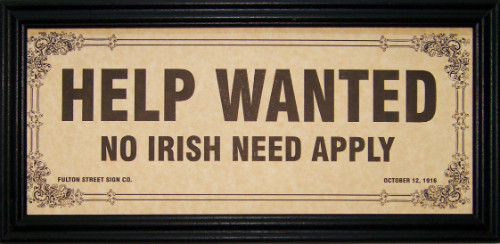
Somewhere along the line a once meaningful metaphor for America has gone the way of all melting pots, it seems, replaced by what? Smorgasbord? We don’t call it that, as yet, but what else does multiculturalism mean when translated into the language of food? The melting pot, of course, was never a very perfect image. It didn’t melt black slaves into whites, not even after slavery ended. Resistant ingredients produced our China Towns—as well as helping build our railroads. The Irish seemed also, at first, resistant to cooking. There were those signs. Don’t try to jump into the melting pot, feller. Not wanted here. But it helped to speak English and to be white. The first signs that we were transiting—thus that the melting pot had holes—was the use of hyphenated-American expressions. Race was there all along, euphemized into “ethnicity.”

What led to the above, however, wasn’t thinking about the melting pot but what was under it: the fire. While wealth was expanding, the pot still melted, even as it leaked and, at its bottom, kept accumulating residues that just would not, absolutely Would. Not. melt. What seemed in the past, indeed quite effectively still when I came to this land (1951), to cause the integration of immigrants was a combination of cultural and physical similarity and ample wealth. Those were the causes rather than the lofty ideas enshrined in the Declaration or the Constitution. Now the fire is sputtering—and hence the pot is cooling. The contents are drying up. And cracks are forming on the surface. I look at politics over the last two decades or so—and at ethnic demographics—and wonder... Is the white population beginning to feel hemmed in by growing ethnic minorities on all sides? Is that what all the passion is about? President Obama only won 43 percent of the white vote in 2008, for instance (link). Isn’t there enough fire for everybody? Should we therefore make the pot smaller—so that all the fat can rise to the top?
---------------
The sign shown may be purchased from the Irish Brigade Store for $19.95 (link).

Tuesday, June 12, 2012

Culture and Civilization

The distinct meanings of these two words emerge fairly well when we speak of ourselves as a “multicultural society.” The unspoken meaning in that phrases is that we are now a “civilization.” In a designation like Greek or Roman culture, the two are hopelessly blended. Something like Greek culture existed in a more or less pure form, but when Athens and Sparta staged their early version of a, for them, world war, they had developed into civilizations. I imbibed this way of treating the two words when, anciently, I read Oswald Spengler’s Decline of the West. For Spengler Kultur was the early, growing phase of a great collective, Zivilisation the later stage.

The root of culture is cultivation, thus agriculture, tilling, the Latin cultus—but that word also includes extensions of meanings like care and labor to include worship and reverence. Thus at the base of culture—religion.  At the base of civilization—the city. The root of the word is the Latin civis, meaning a townsman, later citizen, and from that came civitas, the city, replacing the original for that word, urbs; we still, of course, have urban areas and the behavior that goes with it (we hope), urbanity—when we are not civil.

In the life of the great big collectives, we move from very small settlements and larger aggregations of these held together by a common mode of worship—to vast urban conglomerations in which the transcendental view has thinned out to become a lifestyle. By the time we reach multiculturalism, culture is seen by the organs of civilization as an irrational residue to be tolerated as a civility.

Saturday, March 27, 2010

Multiculturalism

In the context of American life today the word is intended as an admonition. Be tolerant of the Other. Tolerance is ever more needed not only in the United States, long the home of multiple cultures some of which have refused to melt in this famous melting pot. More and more Europe needs to cultivate this attitude as Arabs, Africans, Hindus, and Turks settle in ever large numbers. In post-war Europe Brigitte and I discovered that you didn’t have to be culturally different to be labeled the Other—even if you were from Europe but had moved. The locals in Bavaria were just as tense about German-speaking Flüchtlinge (the refugees) who settled among them as the French today are tense about Arabs.

I am for multiculturalism provided that, using that phrase, the value of culture is not reduced to a secondary quality, like hair color or mode of dress. I favor genuine multiculturalism, thus the effort to understand other cultures from the roots on up—in order to understand how other people think and feel about reality. Some differences are fundamental and strain tolerance. A good example of this is the Christian and the Muslim attitude toward governance.

In the Christian conception of reality, church-state separation rests on Jesus’ words reported in Matthew 22:21: “Render therefore unto Caesar the things which are Caesar’s; and unto God the things that are God’s.” In the Muslim culture, religion and governance were fused from the start; Islamic law, Sharia, is at once civil and religious. In that culture living at arm’s length from the secular world is not really an option; such a life is, by definition, a temporary accommodation to a bad situation that, Inshallah, will someday be righted. It’s valuable to know that while dealing with Muslim countries. It produces problems that can’t be resolved by compromise.

At some higher level than the one where we now live, the differences between cultures are transcended. From that level—but we’re not there yet—differences appear like the different portions of the splendid wrought-iron inset I’m showing today. They’re all part of the same design and all connected. Knowing cultures deeply brings that higher design into view.

Monday, October 19, 2009

Qualms about Culture

Has multi-culturalism gone underground? I think it has. But using a word like culture, I’m necessarily talking about a mysterious structure nobody can reduce to a science; hence I go by hunches and feelings. A laudable impulse to promote toleration lies behind that notion, but little in the way of reasoned reflection. Behind that idea is the understanding that culture is something like self-expression, akin to that peculiarly modern concept of Speech. Since any human action may be interpreted as speech in New-Speak, multi-culturalism translates in practice to free expression. What proponents of this kind of toleration overlook is that culture contains more than manners, dress, social behavior, customs, rituals, and language. Cultures more potently enforce relationships between people and carry values at their core.

Rightly or wrongly, I’ve always interpreted the idea of multi-culturalism as asserting that all cultures are equal; that amounts to saying that all value-systems are equal. There I demur. Cultures are certainly containers of good and bad habits. They transcend time in that the past is still actively present in them (as habit) and they also carry theories of the future. Ours, at present, still has a progressive character; a habitual mode of feeling in our culture is that the future will be an improvement over the past; some of our uneasiness at present comes from observing that this may not be true. Once we’ve digested that message, the culture will change again.

Cultures are particularly different in defining male-female relationships. The western culture still carries residual strains of the Roman view that the male head of the family is a law onto himself. The same sort of barbaric view colors Hindu culture too; widows once were ritually burned when their “owner” passed on. The biological destinies of humans are, to be sure, a kind of natural imperative. The child-bearing female and the needs of the child have produced the division of labor between males and females. These are blurred in our super-rich modern civilization. And, over time (if power really tends to corrupt, as we routinely repeat) the male, dealing with the dangerous outside world, began to exert dominance inward as well as out. That’s a bad habit. The culture crystallized and made it legitimate. Why? Males, who shape the Outer, liked it that way. The Muslim culture, despite the Prophet’s mostly token attempts at reform, reflects the cultural modes of the Arabs of the time of the founding—which was not that different from the Western way. Hence, there too, the males dominate in ways we find outrageous; female genital mutilation in Africa is an extreme example. It takes enormous efforts to imagine a culture in which female dominance was an accepted habit, yet we have some, to be sure almost eroded, traces suggesting that once it was so.

But to return to my initial thought: multi-culturalism has gone underground, or so it seems to me, as soon as external conflict, thus the 9/11 attack, reminded us that cultures carry value systems. And once we’ve become sharply aware of that, the promotion of this kind of thing becomes difficult to maintain consistently. We are forced to think about details, the values that cultures carry, not merely outward and peripheral matters like dress. And even regarding dress, there is the Muslim veil and, worse yet, the full-bodied burqa with slits or holes in the head-piece where the woman can modestly to peer out. (I am making horrid faces at my screen.) You cannot draw arbitrary lines anywhere. Cultures are eco-systems on another plain above the physical but impress their patterns even on dress. And these methods of enforcing “modesty in dress” (hijab) have a lot to say about male dominance and the structure of values that underlies it. As for our own aggressively projected public sexuality—that too proclaims a kind of value system that, if we reflect upon it rationally, is no better. Indeed, as feminists have rightly pointed out, it too promotes a false relationships between men and women.