Thinking of
The Thinker yesterday reminded me of my youth in Kansas City. A full-size reproduction of Auguste Rodin’s statue stood, or should I say sat, at the back entrance of the William Rockhill Nelson Gallery of Art. The original may be found in the Musée Rodin in Paris.
The Gallery (as we used to call it) was within walking distance of our house (for Europeans, anyway); we visited frequently enough so that the place became almost an extension of our ordinary environment. My mother, the Beatrice of
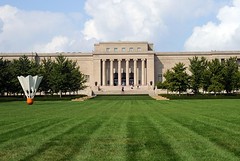
my life, lead the way in this venture as she did in all things cultural. The Gallery has greatly expanded since. Its long name is actually even longer. It is the William Rockhill Nelson Gallery of Art and Atkins Museum of Fine Arts. This name is now officially rendered as the Nelson-Atkins Museum of Art. The museum was opened in 1933. In 1993, long after we’d left Kansas City, a rather stunning but very modernistic new wing, the Bloch Building, was added to the western side of it—creating one of those weird hybrids of modernity. In the manner of the day, which still worships Progress even as tides of barbarism are rising slowly on all sides, most photographs of the Nelson-Atkins show the modernistic façade.
Long names are the consequence of our desire to be remembered—which is aided by great wealth. William Rockhill Nelson was the founder of the
Kansas City Star; Mary McAfee Atkins was a wealthy widow. In these situations I’m always anxious not to sound—or even to be
thought to sound critical. I don’t mind long names and don’t mind remembering those who gave their wealth so that the more humbly endowed can benefit. For each such donor there are countless others who give nothing to the collective at all.

The Gallery is on the edge of a district known as the Plaza, an extensive, ornate, and rather up-scale sort of shopping and office region. Midwest Research Institute (MRI, another of my alma maters) and the Gallery are to the East; St. Luke’s Hospital, where Michelle, was born is to the North; and the Kansas suburbs, where we lived for some years, lie to the west beyond State Line road not too far away. The second photo, taken from the front steps of MRI looking north) shows the Volker Fountain, a wondrous and amusing piece of art of which I’ve written before on
Ghulf Genes (
here) and which I like well enough to show its picture yet again.
The Volker Fountain? Well, behind it was William Volker, a man who made a fortune making picture frames. He gave away his fortune anonymously; indeed, he was known for a long time as Mr. Anonymous—because nobody knew the name of the donor. One of his donations was a large mansion and land around which, a little to the south and east of this fountain, the University of Kansas City took shape—another Kansas City institution with great merit, not least a splendid theater. Eventually anonymity also fades. And hence this fine fountain received Volker’s name…


